
Engineers Network
  • Home
  • About Us
  • Privacy Policy
  • Contact Us
  • Sitemap
  • Write for us
Home  /  About Engineering  /  An introduction to vacuum conveying

An introduction to vacuum conveying

Paul Faillace June 27, 2017 About Engineering Leave a Comment

You probably first encountered vacuum conveying at school through the straw in your milk carton. Once you realised you could either suck or blow, you pretty much got it.

Of course, in industrial settings, the equipment is considerably more sophisticated and bigger. It’s also used for moving a wide variety of materials, some of which need protecting from the environment – or the environment from them.
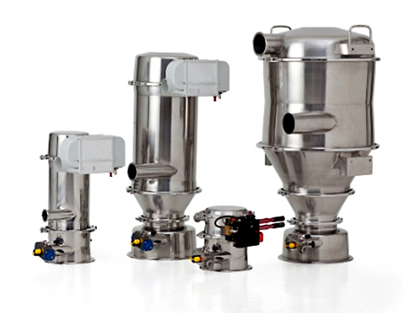
An introduction to vacuum conveying

Image Credit

Hygienic containment

Vacuum conveying is ideal for moving large quantities of material while minimising atmospheric leakage. A vacuum conveyor uses an exhauster near the receiver to create airflow. It can be regulated for continuous flow or deliver timed batches, whichever suits the receiving process or the arrival of supplies. The distances vary between a few feet and many hundreds of metres, and one of the great advantages of a pneumatic system is that it is easily routed around existing plant machinery and involves less equipment to maintain or break down.

Vacuum systems are better suited to lower throughput and shorter distances than positive pressure conveying, but in both cases, controlling equipment is focused at the ends. Varieties of feeder and receiver mechanisms exist, but control can often be centralised at a single panel or integrated into a robotic system. Multiple delivery routes are possible, although multiple points of origin are easier with vacuum systems and multiple points of delivery with positive pressure.

Flow density

Pneumatic conveying is further divided into “dilute” and “dense” phase options. Dilute is the term used when there is a high ratio of flowing air lifting a cargo of light particles such as flour, sugar or chemical powders. In dense phase, the air flow is gentler and the material is rolled through at a denser ratio. The latter is often chosen for materials that are delicate or prone to separation.
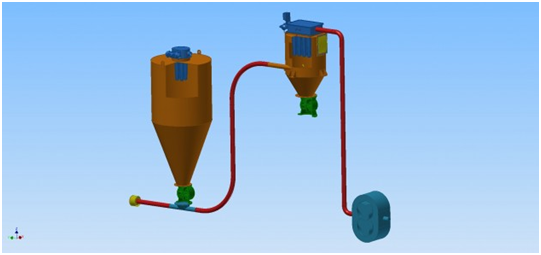
An introduction to vacuum conveying2

Image Credit

A pneumatic conveying consultant will advise you whether to use vacuum or pressure, dilute or dense phase, and the numerous delivery and receiver mechanisms like those at http://www.aptech.uk.com/pneumatic-conveying/vacuum-conveying/). A very good guide to the density of common foodstuffs and industrial materials can be found here: http://www.bulksolidsflow.com.au/free_programs/bulk_density/bulk_density.html.

Your consultant will precisely calculate the pressures and pipeline dimensions required to move your material based on its bulk density, your plant throughput, and the chosen route. Some materials behave in unusual ways, but this, too, can be anticipated.


Previous Article
Next Article

About Author

Paul Faillace

Related Posts

  • Engineers networking at a professional event to build strong career connections

    How to Build Professional Engineering Connections: The Ultimate Guide to Career Growth and Collaboration

    April 9, 2026
  • Online workspace showing shared code, documents, and real-time teamwork among engineers

    How to Collaborate With Engineers Online: The Ultimate Guide to Seamless Remote Teamwork

    March 24, 2026
  • The Benefits of Data Analytics in Schools

    The Benefits of Data Analytics in Schools

    February 23, 2026

Leave a Reply

Cancel reply

Recent Posts

  • Engineers networking at a professional event to build strong career connections
    How to Build Professional Engineering Connections: The Ultimate Guide to Career Growth and Collaboration April 9, 2026
  • Online workspace showing shared code, documents, and real-time teamwork among engineers
    How to Collaborate With Engineers Online: The Ultimate Guide to Seamless Remote Teamwork March 24, 2026
  • Boiler switching off: common culprits March 13, 2026
  • An Introduction to Solar Shading March 10, 2026

Categories

  • About Engineering
  • Aeronautical Engineering
  • Agricultural Engineering
  • agricultural machinery
  • Architectural Engineering
  • Artificial Intelligence
  • Automotive Engineering
  • Biochemical Engineering
  • Biomedical Engineering
  • Chemical Engineering
  • Civil Engineering
  • Computer Engineering
  • Ecological Engineering
  • Electrical Engineering
  • Engineering Career
  • Environmental Engineering
  • Food Engineering
  • Foreign Article
  • Genetic Engineering
  • Industrial Engineering
  • Mechanical Engineering
  • Medical Engineering
  • Nanotechnology
  • Petroleum Engineering
  • Reviews
  • Solaris Engineering
  • Space Systems Engineering
  • Technology
  • Telecommunication Engineering
  • Types of Engineering

Random Posts

  • Great Strategies To Boost Your Social Media Presence April 19, 2021
  • The creation of spill kits February 20, 2023
  • TALKAO API June 7, 2022
  • Going to Maynooth University in Ireland and lucky enough to obtain a scholarship. June 30, 2022

Popular Posts

  • Engineers networking at a professional event to build strong career connections
    How to Build Professional Engineering Connections: The Ultimate Guide to Career Growth and Collaboration April 9, 2026
  • Aims & Objectives December 17, 2015
  • Our Goal December 17, 2015
  • space station
    Russia wants its own space station December 28, 2015
Theme by ThemesPie | Proudly Powered by WordPress