
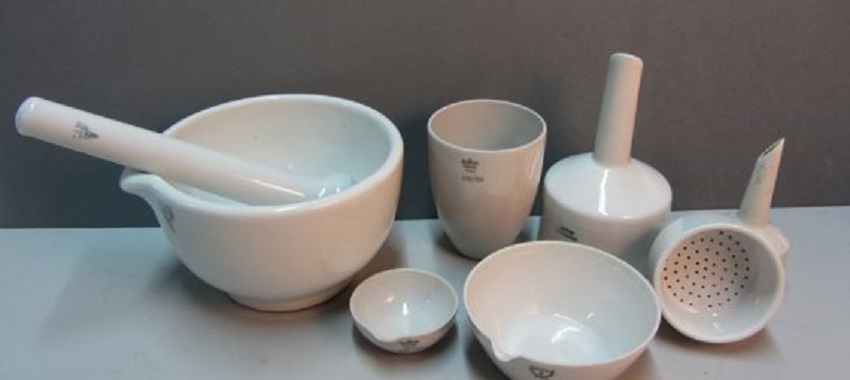
The materials Labware porcelain pieces are used by scientists and people who perform physical analysis and chemical substances. When it is necessary to subject samples to high temperatures, we must make sure that the containers that we use are not going to break, the material indicated for these cases is porcelain.
Porcelain is composed of a white ceramic that has compact properties, it is fragile, resonant, waterproof, and hard, each of these characteristics makes up a resistant material, which can be used to make all kinds of objects, from vessels, condensers, sculptures, vases, cups, among others.
In the field of physics and chemistry laboratories, porcelain is used to create parts resistant to high temperatures, capable of withstanding thermal and chemical attacks that can damage or spill the samples.

What are the Porcelain Laboratory Materials?
This list gives you quick access to the most popular Porcelain Laboratory Materials;
Porcelain is a resistant material that is used in the artisan or industrial field. There are four types of porcelain: soft, kaolin, bone ash, and French. The laboratory materials are made of hard and resistant porcelain. Here are the most common porcelain lab supplies:
Mortar
- Porcelain crucible
- Buchner funnel
- Porcelain rack
- Porcelain tripod
- Porcelain spatula
- Porcelain triangle
Each of these porcelain utensils is useful for heating, holding, and melting substances, solids and liquids, without breaking or spilling their contents.
Porcelain Laboratory Materials According to Their Function
Porcelain laboratory materials are very useful in various physical and chemical procedures; they are used to dissolve mixtures by evaporation, melt mixtures, or heat sinks at high temperatures. According to their function, laboratory materials can be classified into:
To warm
When substances are very dense, it is necessary to melt them to study and analyze their properties, for this, it is essential to use resistant porcelain utensils such as:
Porcelain crucible
The porcelain crucible is a bright white container with a diameter of 10 cm. It is very useful in laboratories because substances can be melted or heated to over 500 ° C.
This material is designed to be used directly on the flame of a lighter without breaking or cracking, all this, thanks to its manufacturing components including clay and graphite.
Porcelain combustion boat
It is a container made of unglazed porcelain that is used to melt substances at maximum temperatures of 1350 ° C, its diameter is 88 x 10 x 13 mm.
By using these containers properly you will be able to carry out your experiments without problems.
Support
By subjecting the mixtures to high temperatures, an instrument is required to hold the utensils while they heat up, porcelain materials are ideal for these processes because of their resistance to high temperatures. Here are some of them:
Porcelain rack
It is an instrument used to store test tubes, whether they have samples inside or not. Be careful with this material because there is a risk that it may break if dropped.
Porcelain Tripod
It is an instrument that is used as a support for materials that are generally subjected to the flames of a lighter. Porcelain tripods allow you to hold any container, crucible, or glass that is placed on it, over it an asbestos grid is placed that generally filters the heat and allows solid or liquid mixtures to be heated.
Porcelain Triangle
This material is frequently used in chemistry laboratories when conducting experiments or analysis with hot substances. The porcelain triangle is used on a universal stand and then hot objects such as flasks and beakers are placed on it.


Leave a Reply