
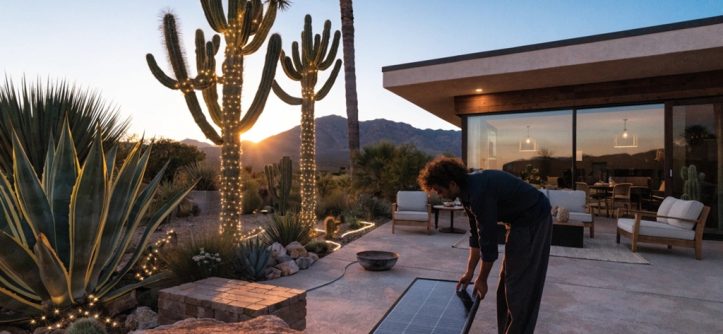
Decorating your home for the holidays in the desert comes with a unique set of challenges. The intense sun that gives you energy during the day can also cause cheap plastic to fade, crack, and become brittle within a single season. At the same time, the cooler nights and lack of cloud cover mean your lights need to work efficiently when temperatures drop. If you are searching for solar christmas lights for desert areas, you have probably noticed that most generic options are not built to survive the Southwest climate. This guide explains exactly what to look for, what to avoid, and how to choose a set that will still be working when January rolls around. We break down the materials, battery types, and design features that actually matter in an arid environment so you can buy with confidence and avoid wasting money on lights that fail by New Year’s Day.
Key Takeaways
- Look for lights with UV-stabilized plastic or glass lenses, as standard plastic degrades quickly in intense desert sunlight.
- Opt for lithium batteries over NiMH, as they handle extreme temperature swings more reliably and hold a charge longer.
- Choose a light with a separate solar panel rather than an all-in-one unit so you can position the panel in direct sun while placing the lights in shaded areas.
- Pay attention to the IP rating and look for at least IP65 to protect against dust storms and monsoon moisture.
- In hot desert climates, warm white tends to outlast and outperform colored LEDs that rely on coatings, which can fade or peel under UV exposure.
Why Desert Conditions Are Hard on Solar Christmas Lights
The desert is not just hot; it is an environment with multiple threats working against outdoor electronics simultaneously. Solar Christmas lights fail in the desert for three primary reasons: UV degradation, extreme temperature swings, and dust exposure.
UV radiation is the biggest culprit. The sun in Arizona, Nevada, New Mexico, and parts of California is significantly more intense than in other regions. UV rays break down the molecular structure of standard PVC and plastic wiring, causing it to become stiff, then brittle, and eventually crack. This is why a set of lights that lasted three years in Ohio might not survive one full season in Phoenix.
Temperature swings are the second issue. The desert is famous for drastic changes between day and night, especially in late fall and early winter. A solar panel that hits 140 degrees Fahrenheit in the afternoon sun must then operate efficiently when temperatures plunge into the 30s overnight. This constant expansion and contraction stresses both electrical connections and battery chemistry.
Finally, dust and sand work their way into unprotected components, scratching lenses, clogging seams, and reducing solar panel efficiency. A tiny amount of fine dust on a solar panel can reduce its output by 10–15 percent, significantly shortening the number of hours your lights stay on each night. When searching for solar christmas lights for desert areas, all three of these factors should influence your buying decision.
What to Look for When Buying Solar Christmas Lights for Desert Climates
Not all solar lights are built to withstand harsh arid environments, and crucial differences like UV-resistant wiring, heat-tolerant batteries, and dust-sealed solar panels rarely stand out on a basic product listing. Evaluating these high-performance specs before buying ensures your holiday display survives intense desert sun and temperature drops without fading or losing power. For a seamless setup, integrating these resilient solar strings alongside broader strategies like 4 Smart Outdoor Lighting Options for Your Home allows you to maintain an elevated, energy-efficient glow across your entire landscape year-round.
UV-Resistant Materials and Construction
The most important factor for desert living is resistance to sunlight damage. Look for product descriptions that explicitly mention UV protection, UV-stabilized plastic, or UV-resistant housing. This applies to both the wiring and the light casings.
Wiring materials matter significantly. Lights with TPU or rubberized cables resist UV around twice as long as basic PVC wiring. The light sockets and housing should also be solidly constructed, preferably with a matte or opaque finish. Clear or translucent plastics without UV inhibitors will cloud over quickly, reducing the light output and making the entire string look aged and yellowed.
Glass or tempered glass lenses are excellent options if you can find them, though they are heavier and more expensive. They do not fade, crack, or become opaque the way plastic lenses eventually will. If you are planning to make an investment in permanent or semi-permanent holiday lighting, the upfront cost is worth it for the longevity.
Battery Type and Longevity
Most cheap solar lights come with NiMH (nickel-metal hydride) rechargeable batteries. They work fine in moderate climates, but they degrade quickly in high heat. The desert sun can permanently damage NiMH cells, causing rapid self-discharge and reduced capacity within weeks of exposure.
Lithium-ion batteries are a better choice for desert environments. They handle high temperatures more gracefully, discharge more slowly, and maintain consistent voltage until they are nearly empty. Many higher-quality solar lights now include lithium cells, and it is worth paying extra for them. If your lights do not come with a battery type listed in the specifications, assume they are NiMH and consider replacing them with lithium equivalents as an immediate after-purchase upgrade.
IP Ratings: What They Actually Mean
The IP (Ingress Protection) rating tells you how well a device is sealed against dust and water. For desert areas, the first number—the dust protection number—is more important than the second.
Look for an IP rating of at least IP65. This means complete protection against dust ingress and low-pressure water jets. IP67 or IP68 provides even better protection against immersion, but that level of waterproofing is rarely necessary for hanging lights. Avoid anything rated below IP65, especially in areas that experience high winds and blowing sand.
Design Types: All-in-One vs. Separate Solar Panels
The physical design of the solar light system is a major decision point that affects both performance and placement flexibility.
All-in-One Solar Lights
These designs have the solar panel, battery, and light-emitting diodes (LEDs) all in a single small unit. They are common for pathway markers, tiny decorative lights, and some net lights. In the desert, all-in-one lights are often problematic because they must be placed where they receive direct sunlight for charging, while also being positioned where you want the light output.
- Pros: Easy installation, no wiring between panel and lights, compact
- Cons: Less control over optimal panel placement, limited battery size, frequently made with lower-quality UV plastic
Separate Panel Systems
These systems have a solar panel that connects to a string of lights via a cable. The panel can be placed on a roof, a stake in the ground, or mounted on a wall in full sun, while the lights themselves go under eaves where you actually want the glow. This is nearly always the better choice for desert decorating.
- Pros: Maximum flexibility for sun exposure, larger battery capacity, better thermal management (the panel can heat up without cooking the battery)
- Cons: More visible cabling, more complex installation planning, generally costs more
Our recommendation for the Arizona and Southwest climate is to choose a separate panel system whenever possible. The heat generated at the panel will not compromise the battery, and you are not forced to chase the sun around your yard with your lights. You can explore specific high-temperature options for solar christmas lights for desert areas that use separate panel designs and temperature-rated components.
The Role of Color Temperature and LED Types
The color and type of LEDs you choose also affect how well your lights perform in the desert.
Warm White vs. Cool White vs. Color
Warm white LEDs generally last longer than colored LEDs in extreme sunlight. The colored options rely on a phosphor coating that can degrade with UV exposure, causing the color to shift, dim, or become uneven across the string. Warm white uses a simpler LED construction that is generally more robust.
If you want colored lights for your holiday display, look for models that use colored LED chips rather than white LEDs with a colored lens or coating. Colored chips are inherently more UV-stable because the color is integrated into the diode material itself rather than applied to the lens.
LED Quality
Low-quality LEDs can degrade in the heat even before the plastic casing gives out. Look for lights that specify branded LED diodes or high-lumen per-watt efficiency. The efficiency matters because lower quality LEDs generate more heat per lumen, which strains the system in a hot environment.
As a general rule, expect to pay more for LED counts and quality. A string of 100 cheap LEDs is less useful in the desert than a string of 50 premium LEDs that remain bright after two or three seasons.
Installation Tips for Maximum Sun Exposure in the Desert
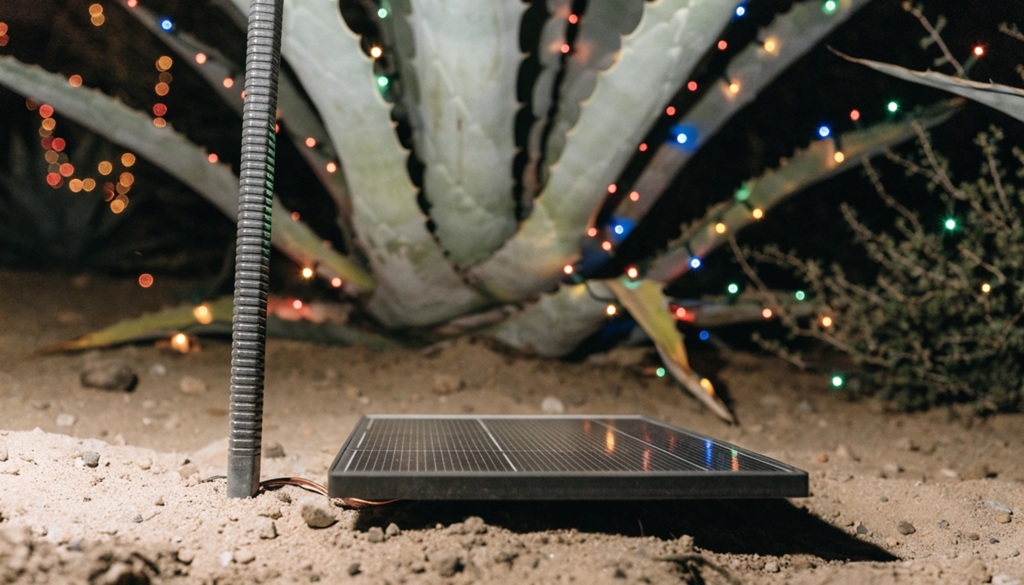
Even with the perfect solar lights, poor installation can make them underperform. Positioning and seasonal adjustments matter more in the desert because the sun’s path changes during the holiday season (November through January).
Panel Orientation
In the Northern Hemisphere during winter, the sun is lower in the sky and more tilted to the south. If you mounted your panel to receive summer sun, it will likely not perform well for Christmas lights.
For maximum winter charging in the desert Southwest, angle your solar panel to face true south (not magnetic south) at approximately 45 degrees. If your panel is flat or angled slightly east, you will lose several hours of optimal sunlight each day.
Cleaning Schedule
Dust accumulation is a year-round issue but hits the hardest right after monsoon storms and strong wind events. Touch the surface of your solar panel with your finger. If you can see a faint line where your finger wiped away dust, the panel needs cleaning.
Clean panels with a soft, damp cloth—never abrasive pads or chemical cleaners. A simple water rinse to remove loose dust will recover most of the lost efficiency. Cleaning once every two weeks during December is sufficient in most desert locations.
Battery Maintenance and Replacement
Batteries are the most likely component to fail first in a solar light system. In the desert, heat accelerates all battery chemistry degradation. Plan on replacing the batteries in your solar lights every one to two years if you want to maintain consistent performance.
If your lights are dimming earlier in the evening than they did in the first week of use, that is a clear sign the battery is losing capacity. Replace with a high-temperature-rated lithium rechargeable battery that matches the voltage requirement of your light set. Installing a battery with higher mAh capacity can extend runtime, as long as the solar panel can fully recharge it on a sunny day.
For the actual holiday season, consider swapping out the batteries at the start of November. A fresh battery, clean panel, and properly positioned panel will give you the best possible performance during the weeks you actually care about the lights working.
Frequently Asked Questions
Can solar Christmas lights work in winter in the desert?
Yes. The desert southwest has abundant winter sunshine, often with more clear days than even summer months. Even though daylight hours are shorter, the intensity of the sun on clear winter days is sufficient to fully charge a properly sized solar panel and battery system. The main issue in winter is the lower angle of the sun, not the lack of light. Adjusting the panel angle to face the winter sun is the most effective solution.
How long do solar Christmas lights last in extreme heat?
With the right materials and proper care, a quality set should last three to five years in the desert. Cheaper sets with basic PVC plastic and NiMH batteries will likely need replacement after one season. The lifespan depends on UV exposure, temperature extremes, and whether you clean the panel and store the lights properly during the off-season.
Should I store solar Christmas lights during the summer?
Yes, absolutely. The summer desert sun is the harshest part of the year for electronics. Removing your lights and storing them in a climate-controlled area adds months to their lifespan. Disconnect the battery, coil the wire loosely, and store in a container that blocks light. Heat exposure during the off-season degrades the battery very quickly, even if the lights are unplugged from the panel.
Are colored lights or white lights better for desert use?
White lights, particularly warm white LEDs, are more durable in the desert because they do not rely on UV-sensitive coatings or tinted lenses. If you prefer colored lights, choose options with integrated colored LED chips rather than lights with painted or coated bulbs. You will get better color stability and longer life.
What is the best solar panel placement for Christmas lights?
The panel should face true south in the Northern Hemisphere. For a December installation in the desert, set it at a 45-degree angle from the horizontal. Avoid placing the panel near roof edges where debris, dust, or bird droppings may accumulate. Ensure no shade falls on the panel between 10 a.m. and 3 p.m. for maximum charging.
Conclusion
Finding solar Christmas lights that work in the desert is not just about buying the most expensive option—it is about selecting the right materials, design, and installation approach. Focus your budget on UV-resistant construction, lithium batteries, and a separate solar panel that you can position for winter sun. Remember that even the best lights need cleaning and off-season storage to deliver reliable performance year after year.
Assess your current holiday lighting setup, check the IP rating on any lights you are considering, and do not hesitate to replace batteries proactively each November. By following these guidelines, you can enjoy beautiful, energy-free Christmas lighting that survives the Arizona sun and keeps your holidays bright for many seasons to come.


Leave a Reply