

Imagine hearing music clearly while your ears remain completely open — no earbuds, no canal blockage, just sound that seems to come from inside your head. That’s not science fiction; it’s how bone conduction headphones have worked since the technology was first used in hearing aids decades ago. Instead of sending sound waves through the air into your ear canal, bone conduction headphones transmit vibrations through your cheekbones directly to your inner ear, bypassing the eardrum entirely. The biggest advantage of this approach: your ears stay open to hear traffic, conversations, and your surroundings while still enjoying audio. For runners, cyclists, and anyone who needs situational awareness, this isn’t just a novelty — it’s a genuine safety and convenience breakthrough.
Bone conduction technology has exploded in popularity, with the global market projected to reach $2.8 billion by 2027, driven largely by safety-conscious athletes and people who find traditional earbuds uncomfortable. But the technology involves real tradeoffs — sound quality differs from traditional headphones, bass response is limited, and they’re not ideal for every situation. Understanding exactly how they work and where they excel helps you decide whether they’re right for you. This guide explains the science behind bone conduction, the genuine bone conduction headphones benefits, and whether they’re worth your money.
How Do Bone Conduction Headphones Actually Work?
Bone conduction headphones convert audio into vibrations that travel through your cheekbones (the temporal bone) directly to your cochlea (inner ear), bypassing your eardrum entirely. Transducers resting on your cheekbones in front of your ears create these vibrations.
The science step-by-step:
- Audio signal: Your device sends an audio signal to the headphones via Bluetooth.
- Transducers vibrate: Small transducer pads resting on your cheekbones (just in front of your ears) convert the signal into mechanical vibrations.
- Bone transmission: These vibrations travel through your skull bones directly to the cochlea, the spiral-shaped organ in your inner ear.
- Sound perception: Your cochlea interprets the vibrations as sound, just as it would with traditional air-conducted sound — but the eardrum is never involved.
This is the same way you hear your own voice from inside your head — through bone conduction. It’s why your recorded voice sounds different to you than your live voice; recordings only capture air-conducted sound, while you normally hear yourself through both air and bone conduction.
What Are the Main Benefits of Bone Conduction Headphones?
The main benefits are situational awareness (open ears), comfort (no in-ear pressure), hygiene (no canal contact), and suitability for people with certain hearing conditions or those who find earbuds uncomfortable.
Key bone conduction headphone benefits:
- Situational awareness: Your ear canals stay completely open, letting you hear traffic, approaching people, announcements, and your environment. Critical for outdoor safety.
- All-day comfort: No pressure in or on your ear canal. Many people who can’t tolerate earbuds find bone conduction comfortable for hours.
- Hygiene: Nothing enters your ear canal, reducing earwax buildup, ear infections, and moisture issues common with in-ear designs.
- Hearing condition suitability: Helpful for people with certain types of hearing loss (conductive) or conditions where in-ear devices are problematic.
- Sweat and exercise friendly: Most are water-resistant and stay secure during workouts without falling out like earbuds.
- Reduced ear fatigue: No sealed canal means less of the “plugged” feeling and listening fatigue some experience with earbuds.
What Are the Drawbacks of Bone Conduction Headphones?
The main drawbacks are reduced sound quality (especially limited bass), sound leakage at high volumes, less effectiveness in very noisy environments, and a tickling vibration sensation that some users notice at high volumes.
Honest drawbacks to consider:
- Limited bass: Bone conduction struggles to reproduce deep bass frequencies. Audiophiles and bass-lovers will notice the difference from quality earbuds or headphones.
- Sound leakage: At higher volumes, people nearby can hear your audio. Not ideal for quiet offices or libraries.
- Noisy environment struggle: Because your ears are open, loud surroundings (busy streets, gyms) compete with your audio. You may need to raise volume, increasing leakage.
- Vibration sensation: At high volumes, some users feel a tickling or itching sensation from the transducer vibrations on their cheekbones.
- Lower maximum volume: Generally can’t get as loud as sealed earbuds, which is good for hearing safety but limiting in loud environments.
- Sound quality vs. price: You pay more for the open-ear convenience than you would for comparable-quality traditional earbuds.
Are Bone Conduction Headphones Safe for Your Hearing?
Bone conduction headphones are generally considered safe and may even be safer than traditional headphones for hearing health, since they don’t direct sound pressure into the ear canal and their open design discourages dangerously high volumes.
Hearing safety considerations:
- No ear canal pressure: Sound isn’t blasted directly at your eardrum, potentially reducing certain types of hearing damage risk.
- Lower volume tendency: Because they don’t isolate, you’re less likely to crank volume to dangerous levels (though noisy environments can tempt you to).
- Still requires volume awareness: Excessive volume over time can still affect hearing via the cochlea. The cochlea is what’s ultimately stimulated, so volume moderation still matters.
- Bypass eardrum issues: For people with certain eardrum or middle-ear conditions, bypassing these structures can be beneficial.
The consensus among audiologists: bone conduction is a reasonable choice for hearing health, particularly for the open-ear safety benefit, but it’s not magic — protecting your cochlea still requires keeping volumes moderate regardless of the technology.
Who Should Use Bone Conduction Headphones?
Bone conduction headphones are ideal for runners, cyclists, outdoor athletes, people who need situational awareness, those who find earbuds uncomfortable, and anyone prioritizing safety and comfort over audiophile-level sound quality.
Best candidates for bone conduction:
| User Type | Why Bone Conduction Works |
|---|---|
| Runners | Hear traffic and surroundings for safety; secure fit |
| Cyclists | Situational awareness critical on roads; legal in many areas |
| Hikers/trail users | Hear wildlife, other trail users, and nature |
| Office workers | Stay aware of colleagues and calls while listening |
| Earbud-intolerant people | No in-ear discomfort or pressure |
| People with frequent ear infections | Nothing enters the ear canal |
Who should NOT prioritize bone conduction:
- Audiophiles who demand premium sound quality and deep bass
- People who want noise isolation to block out surroundings
- Those in very loud environments where open ears are a disadvantage
- Anyone needing maximum volume or privacy (no sound leakage)
How Does Sound Quality Compare to Regular Headphones?
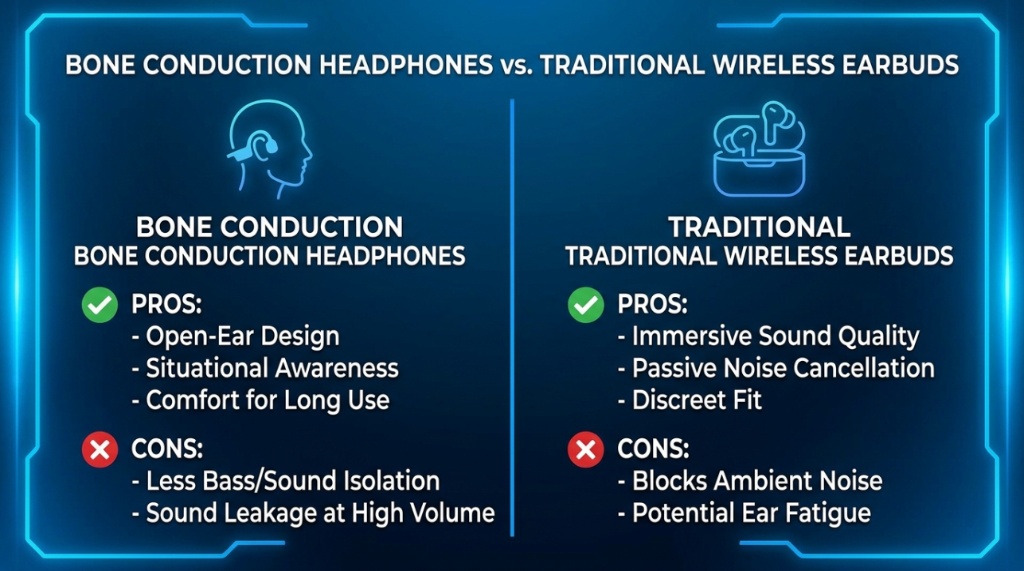
Bone conduction sound quality is good for spoken content (podcasts, calls, audiobooks) and acceptable for music, but it can’t match quality traditional headphones for bass response, detail, and overall richness — it’s a tradeoff for open-ear convenience.
Sound quality by content type:
- Podcasts and audiobooks (excellent): Spoken word reproduces clearly. Bone conduction excels here — the limited bass doesn’t matter for voice.
- Phone calls (very good): Clear voice transmission, and open ears let you hear your own voice naturally.
- Pop, rock, electronic music (acceptable): Listenable and enjoyable, but you’ll notice weaker bass and less depth than quality earbuds.
- Bass-heavy genres (limited): Hip-hop, EDM, and bass-focused music lose impact. The deep low-end bone conduction can’t reproduce well is exactly what these genres rely on.
- Classical and acoustic (good): Mid and high frequencies come through nicely; the limited bass is less critical for these genres.
Set realistic expectations: bone conduction trades sound quality for open-ear awareness and comfort. If you accept that tradeoff for the safety and convenience benefits, you’ll be satisfied. If sound quality is your top priority, traditional headphones remain superior.
Are Bone Conduction Headphones Worth the Money?
Bone conduction headphones are worth it if you value situational awareness, comfort, and safety for activities like running and cycling — the open-ear benefit justifies the sound-quality tradeoff. They’re not worth it if you prioritize audiophile sound or noise isolation.
Value assessment by priority:
- Worth it for: Outdoor athletes (safety), earbud-intolerant users (comfort), multitaskers (awareness), people with ear health issues (hygiene). For these users, the unique benefits are genuinely valuable.
- Not worth it for: Audiophiles (sound quality), commuters wanting noise isolation, people in loud environments, those wanting maximum volume or privacy.
Price consideration: bone conduction headphones range from $30 (budget) to $180+ (premium like Shokz OpenRun Pro). Budget options have improved dramatically, offering genuine open-ear benefits at low prices. You don’t need to spend premium prices to get the core advantages — affordable models deliver the situational awareness and comfort that make the technology worthwhile.
What Should You Look for When Buying Bone Conduction Headphones?
Look for secure fit, adequate battery life (6+ hours), water resistance (IP55+ for sweat), Bluetooth 5.0+, and reasonable sound quality — prioritizing the features that matter for your intended use.
Buying checklist:
- Fit and comfort: The wraparound design should fit securely without excessive pressure. Try to test fit if possible.
- Water resistance: IP55 minimum for sweat resistance; IP67+ for swimming or heavy rain. Match to your activity.
- Battery life: 6–8 hours is standard. More for long activities.
- Bluetooth version: 5.0 or higher for stable connection and efficiency.
- Sound quality: Read reviews about bass response and leakage. Premium models sound better but budget options are increasingly capable.
- Controls: Easy physical buttons for volume, playback, and calls without removing the headphones.
- Weight: Lighter is more comfortable for long wear and exercise.
Whether you are exploring the bustling streets of Tokyo or hiking through remote mountain trails, understanding what is destination travel in the world helps you prepare for the ultimate global adventure. Packing the right gear is essential for these long journeys, and a pair of sleek, open-ear black headphones: the perfect accessory for any music lover will keep you safely aware of your foreign surroundings while enjoying your favorite travel soundtrack.
Conclusion
Bone conduction headphones work by transmitting sound vibrations through your cheekbones directly to your inner ear, bypassing the eardrum and leaving your ears open to your surroundings. This unique approach delivers genuine benefits — situational awareness for safety, all-day comfort, better hygiene, and suitability for people who can’t use traditional earbuds. The tradeoff is sound quality, particularly limited bass and some sound leakage at high volumes.
Are they worth it? For runners, cyclists, outdoor athletes, and anyone who prioritizes awareness and comfort, absolutely — the open-ear safety benefit alone justifies the purchase. For audiophiles and those wanting noise isolation, traditional headphones remain better. The good news is that affordable bone conduction models now deliver the core open-ear benefits without premium pricing, making the technology accessible to anyone curious to try it. Match the choice to your priorities, and bone conduction can transform how you listen during active, aware living.
What activities would you use bone conduction headphones for? Share in the comments — I’ll tell you whether they’re the right choice for your specific use and what features to prioritize.
Frequently Asked Questions
How do bone conduction headphones work?
Bone conduction headphones convert audio into vibrations transmitted through your cheekbones directly to your inner ear (cochlea), bypassing the eardrum. Transducer pads rest on your cheekbones in front of your ears. This leaves your ear canals completely open, letting you hear your surroundings while listening to audio.
Are bone conduction headphones worth buying?
Yes, if you value situational awareness, comfort, and safety for activities like running and cycling. The open-ear benefit justifies the sound-quality tradeoff for these users. They’re not worth it if you prioritize audiophile sound quality, deep bass, or noise isolation, where traditional headphones remain superior.
Do bone conduction headphones have good sound quality?
They’re excellent for podcasts, audiobooks, and calls, and acceptable for most music. However, they have limited bass response and can’t match quality traditional headphones for depth and richness. The sound quality is a reasonable tradeoff for the open-ear awareness and comfort they provide.
Are bone conduction headphones safe for hearing?
Generally yes, and possibly safer than traditional headphones since they don’t direct sound pressure into the ear canal and their open design discourages dangerously high volumes. However, excessive volume can still affect hearing via the cochlea, so volume moderation still matters regardless of the technology.
Can other people hear my bone conduction headphones?
At higher volumes, yes — bone conduction headphones leak sound that nearby people can hear. This makes them less ideal for quiet offices, libraries, or situations requiring privacy. At moderate volumes, leakage is minimal, but it increases as you turn up the volume.
Are bone conduction headphones good for running?
Yes — they’re ideal for running. Your ears stay open to hear traffic and surroundings for safety, they stay secure during movement without falling out, and most are sweat-resistant. The open-ear awareness is a genuine safety advantage for runners on roads and trails.
Do bone conduction headphones work for people with hearing loss?
They can help people with conductive hearing loss (problems in the outer or middle ear) by bypassing those structures and stimulating the cochlea directly. However, they don’t help with sensorineural hearing loss (cochlea or nerve damage). Consult an audiologist about your specific hearing condition.




Leave a Reply